A knowledge platform for well-completion sheets

Knowledge with its roots showing.

Kandi holds a gas field’s 159 source documents and everything two extraction pipelines read from them, and ties every value back to the sheet it was printed on: for the people who read wells, and for the assistants that help them.

A staged demo behind one shared sign-in. Sign in

  • 152 wells
  • 4,936 nodes · 9,013 edges
  • 4 values differ, both shown
assistant · MCP example

Question: How many wells penetrate Habib Rahi, counting its confirmed aliases and subunits?

  1. sparql example 01, with the reasoner’s output
  2. 79 xsd:integer · 1 row

79 wells. The count uses wellPenetratesUnit, which only the reasoner infers. Without it the same query returns 0.

01_wells_in_habib_rahi_rollup.rqgraph_inferred.ttl

Question: At what depth is the surface casing shoe on Mari-71?

  1. conflicts well Mari-71
  2. differ casing[1].shoe · no verdict

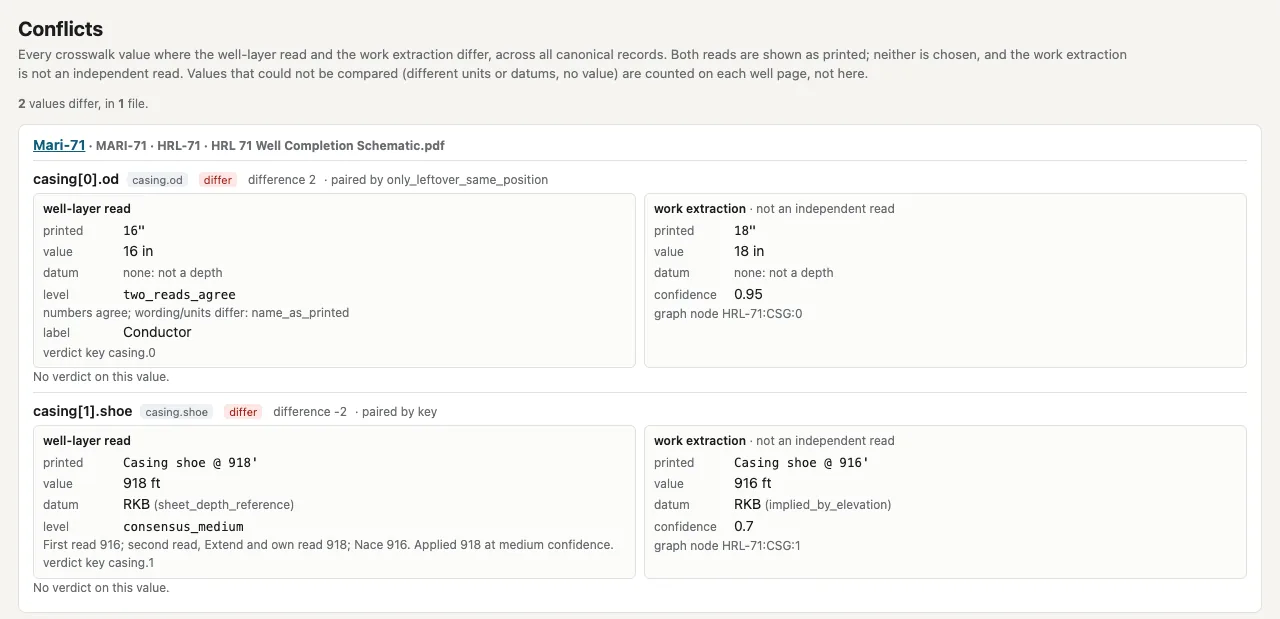
The two extractions differ. Well-layer read: 918 ft RKB (consensus_medium). Work extraction: 916 ft RKB, not an independent read. Neither is chosen.

HRL 71 Well Completion Schematic.pdf

  • Every sheet in one place159 source documents · 157 extracted · 152 wells
  • Both readings, side by side3,714 values · 4 differ · neither chosen
  • A graph that reasons4,936 nodes · 146,568 triples · inferred links
  • Answers with a sourceMCP · 10 read-only tools · stdio and HTTP

How a field becomes a tree, in five steps

paper1 / 5

Undo the tree and you are back at paper.

Every value in Kandi’s graph points to the sheet it was read from. Scroll, and each one goes home: 159 source documents, kept unchanged.

  • 143 PDF
  • 9 xlsx · 6 xls
  • 1 doc

two readings2 / 5

One faded digit. Two readings. Neither is chosen.

Mari-71’s sheet prints a casing shoe that one pipeline read as 918 ft and the other as 916 ft, both from RKB. Kandi shows both, as printed. Of 3,714 values set side by side, 4 differ, and two of them are on this sheet.

The work extraction is not counted as an independent read: it comes from the same model family as the first well-layer read, so its errors are probably correlated.

graph3 / 5

Each value grows back into the graph.

Wells, sheets, casing strings, perforations, depths and formations: 4,936 nodes and 9,013 edges, exported as 146,568 triples over an ontology of 22 classes and 43 relations.

This crown is the real graph: one dot per node, one line per edge, names left out.

  • wells, sheets, equipment
  • depths and elevations
  • formations, shared
  • issues

roots4 / 5

Turn it over, and every root is a well.

A well is a tree upside down: a bore, casing strings and perforations reaching down through named rock. In the platform, 26 wells have a 3D cut-away drawn to the depths on their sheets, each depth with its unit and datum.

Here: one root per well, all 152. Casing strings and perforations per root are counted from the graph. Depths and strata are drawn for illustration, not to scale.

question5 / 5

Ask, and the answer climbs back with its sheet.

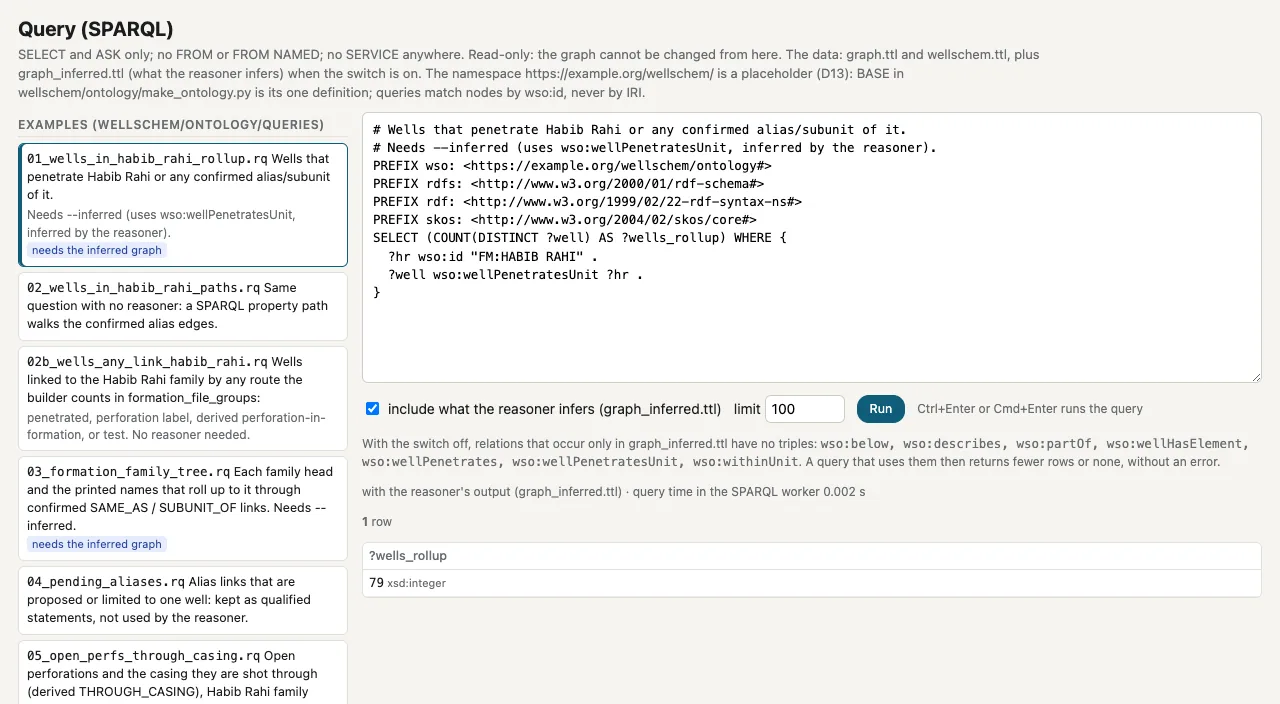
An assistant asks through MCP. Example query 01 follows what the reasoner inferred and finds the 79 wells whose sheets record Habib Rahi or a confirmed alias of it. Without the reasoner, the same query finds 0.

Lit: the 79 wells in the answer. Every row can be followed back to the sheet it came from.
What is inside

Nine views over one set of sheets.

Each view reads the same records. Open a well in one and follow it through the others, down to the source file.

  • Field map and well cards

    Wells on an offline satellite image. Each card shows the printed values and how each was read.

    134 well-layer wells
  • 3D cut-aways

    Bore, casing and perforations drawn to the depths documented on the sheet.

    26 wells
  • Schematics and tables

    Each sheet’s schematic drawing with the tables it printed, beside the page images it was read from.

    157 sheets
  • Knowledge graph

    Wells, sheets and everything they print, as nodes and edges, each traceable to its sheet.

    4,936 nodes · 9,013 edges
  • Ontology and reasoner

    Classes and relations, what the reasoner (owlrl) infers from them, and their OSDU counterparts.

    22 classes · 43 relations
  • Validation

    Eleven rules run in two independent implementations, checks.py and SHACL, and their results are compared.

    9 of 9 agree
  • Source documents

    The original files, unchanged, one link away from any value read from them.

    159 files
  • Query console

    Read-only SPARQL over the graph, with the reasoner’s output on a switch. SQL over the same records goes through the sql tool.

    10 worked examples
  • Assistant endpoint

    The Model Context Protocol over stdio or HTTP. Every tool reads; no tool can write a verdict.

    10 read-only tools

Screens from the platform

The demo, as it runs today.

Screenshots of the platform, cropped to the view and otherwise untouched.

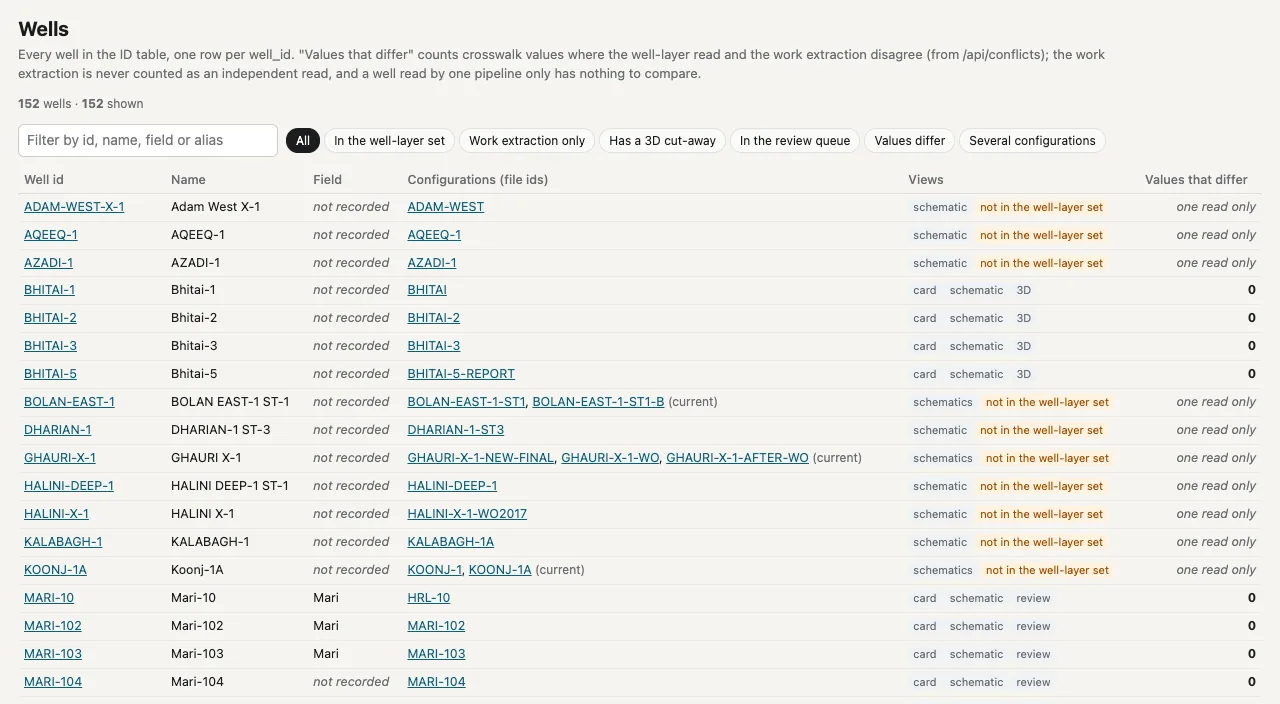
The Wells view: a table with one row per well id, its printed name, field, configurations, the views that exist for it and how many values differ. Filters across the top include: in the well-layer set, work extraction only, has a 3D cut-away, values differ.
Filters for coverage: both pipelines, one pipeline, a 3D cut-away, values that differ.
The Conflicts view: 2 values differ, in 1 file, Mari-71. For each, the well-layer read and the work extraction sit side by side: printed text, value, datum, level or confidence, and graph node. The casing shoe reads 918 ft RKB on one side and 916 ft RKB on the other. No verdict on either value.
Mari-71: both readings as printed, the work extraction marked “not an independent read”.
The Query console: the list of example queries on the left, query 01 in the editor, the switch to include what the reasoner infers turned on, and the result: 1 row, 79.
SELECT and ASK only; no FROM, no SERVICE. The answer, 79, needs the reasoner.
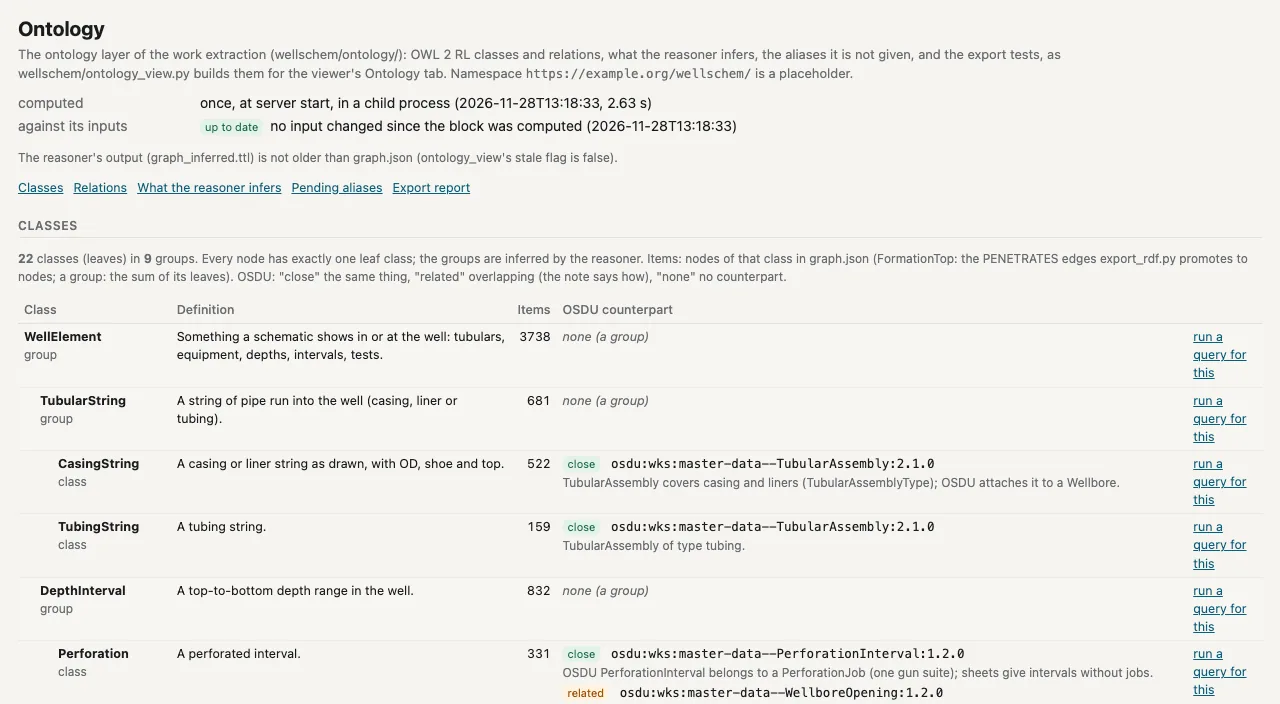
The Ontology view: 22 classes in 9 groups, each with its definition, the number of items in the graph and its OSDU counterpart, for example CasingString with 522 items, close to the OSDU TubularAssembly.
22 classes in 9 groups, with item counts from the graph and their OSDU counterparts.

Provenance first

Printed values are never overwritten.

Kandi says where each number came from, and it says just as plainly what nobody has checked yet.

  • Every depth keeps its unit and its datum (DF, RKB, RTKB, KB…) as the sheet states it; where only one reading states a datum, the two are still compared and marked “datum not stated on one side”
  • Where two readings differ, both are shown and neither is chosen
  • A proposed fix sits beside the printed value and is never applied
  • Values are machine-transcribed, not human-verified
  • Nothing is called verified unless a person verified it. Values confirmed by an agent on a person’s approval are labelled verified-by-agents
  • Reviewing is switched off in this demo; the review page is view-only

Mari-71 · surface casing shoe

differ

casing[1].shoe · HRL 71 Well Completion Schematic.pdf

Well-layer read

printed
Casing shoe @ 918'
value
918 ft
datum
RKB
level
consensus_medium

Work extraction not an independent read

printed
Casing shoe @ 916'
value
916 ft
datum
RKB, implied by elevation
confidence
0.7

No verdict on this value. Both readings stay until a person decides.

For AI assistants

Connect an assistant. It can read; it cannot write.

Kandi serves the Model Context Protocol over stdio on the machine that runs it, or over HTTP with a bearer token. Ten read-only tools, and answer rules the assistant receives with them.

  • sql
  • sparql
  • node
  • search
  • evidence
  • well
  • about
  • reads
  • conflicts
  • review_status
  1. Say how a value was read: one read, two reads agree, three-way, or a person’s verdict.
  2. Call a value verified only when a person entered its verdict; agent-confirmed values are verified-by-agents.
  3. The work extraction is not an independent read. Do not count it toward agreement.
  4. When the two extractions differ, give both values and their sources. Do not pick one.
.mcp.json · over HTTP
{
  "mcpServers": {
    "well-platform-http": {
      "type": "http",
      "url": "https://<your-host>/mcp",
      "headers": {
        "Authorization": "Bearer <token>"
      }
    }
  }
}

The Status page writes this block for you from the running server. Requests that carry an Origin header are refused.

Real queries

The reasoner changes the answer.

Ten worked examples ship with the console. Three of them need what the reasoner infers; without it they return fewer rows, and no error says so.

Rows returned with and without the reasoner’s output
ExampleWith the reasonerWithout
01 wells in Habib Rahi, roll-up790
03 formation family tree23 rows22 rows
06 below the first packer28 rows0 rows

These counts are the platform’s regression baselines. The namespace https://example.org/wellschem/ is a placeholder.

01_wells_in_habib_rahi_rollup.rqsparql
# Wells that penetrate Habib Rahi or any confirmed alias/subunit of it.
# Needs --inferred (uses wso:wellPenetratesUnit, inferred by the reasoner).
PREFIX wso: <https://example.org/wellschem/ontology#>
PREFIX rdfs: <http://www.w3.org/2000/01/rdf-schema#>
PREFIX rdf: <http://www.w3.org/1999/02/22-rdf-syntax-ns#>
PREFIX skos: <http://www.w3.org/2004/02/skos/core#>
SELECT (COUNT(DISTINCT ?well) AS ?wells_rollup) WHERE {
  ?hr wso:id "FM:HABIB RAHI" .
  ?well wso:wellPenetratesUnit ?hr .
}

79 xsd:integer · 1 row · with the reasoner’s output

By the numbers

Every figure on this page, counted.

Counted from the platform’s build of 28 November 2026. Nothing here is rounded or estimated.

  • 159source documents143 PDF, 9 xlsx, 6 xls, 1 doc
  • 157sheets extracted134 read by both pipelines, 23 by one
  • 152wellsone per well id
  • 3,714values side by side4 differ; 265 could not be compared
  • 4,936graph nodesjoined by 9,013 edges
  • 146,568triplesin the RDF export
  • 22 · 43classes · relations22 leaf classes in 9 groups
  • 9 of 9validation results agreechecks.py against SHACL
  • 10read-only toolsover stdio or HTTP
  • 10example queries0.002–0.30 s each, once the graph is loaded
  • 263D cut-awaysdrawn to documented depths
  • 79wells in Habib Rahiexample 01, with the reasoner

Open it

Pick any value. Follow it to its sheet.

The platform is open to the demo’s shared sign-in. Assistants connect from the Status page.

A staged demo: one shared sign-in, reviewing switched off, values machine-transcribed and not human-verified.